

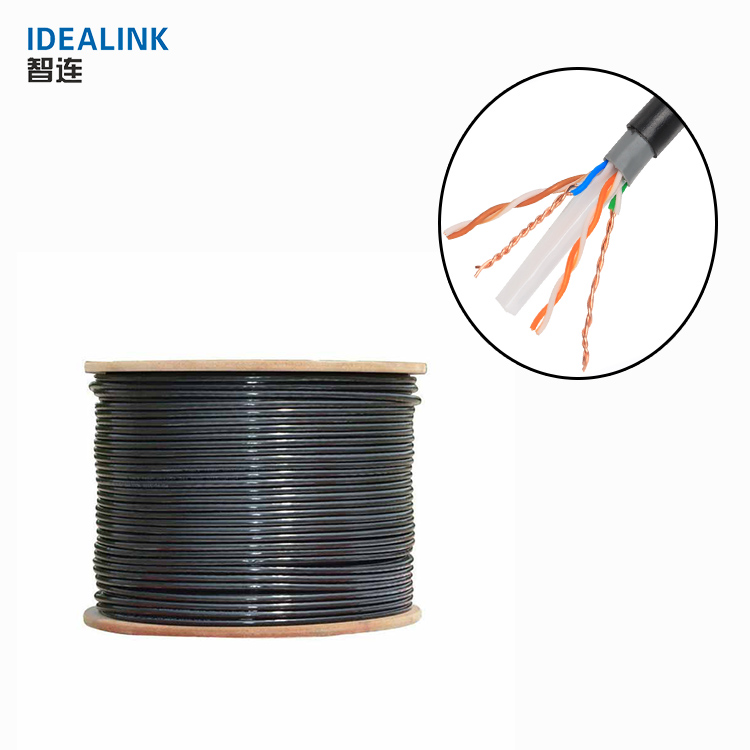
Ask any home networking forum how to get ethernet to a detached building and the replies pile up fast. The pattern in them is always the same: people either overpay for outdoor-rated cable they don’t need, or they bury indoor cable and dig it up again in eighteen months. This guide should keep you out of both groups.
Done right, one afternoon of digging buys you a decade of gigabit to the garage. Done wrong, it buys a redo.
Step 1: Pick your route before your cable
There are only three ways to get ethernet outside, and the cable follows the route, not the other way round.
| Route | Cable you need | Typical cost picture |
|---|---|---|
| Conduit between buildings | Any solid-copper Cat6, pulled through the pipe | Upfront labor; cheapest long-term |
| Clipped along a fence or wall (shaded) | UV-rated outdoor Cat6 with a PE jacket | Low, if shaded and off the ground |
| Direct in the dirt | Direct-burial rated Cat6 (gel-filled / water-blocked) | Moderate; never skimp here |
The rule the forum veterans repeat: conduit beats burial. If you can dig the trench anyway, drop in cheap 20–25 mm conduit and pull whatever cable you like. Your next upgrade becomes a 20-minute pull instead of a weekend with a shovel.
When burial is the only option, use a proper outdoor Cat6 with a double PE jacket built for underground runs, or step up to armored direct-burial SFTP where rodents or rocks are a real risk.
Step 2: Understand what “outdoor” actually means
Two separate problems, two separate ratings, and listings love to blur them:
UV resistance. Ordinary indoor PVC jackets are not UV-stabilized. In direct sun they chalk, crack, and expose conductors within one to two summers. Outdoor-rated cable uses polyethylene (PE) that survives sunlight for years. Look for “UV-resistant” or “suitable for outdoor exposure” in writing, on the listing and on the jacket.
Water blocking. Buried cable lives in water, not maybe, but seasonally. Direct-burial (sometimes marked “DB” or “flooded”) cable is gel-filled or wrapped in water-blocking tape so moisture can’t wick along the conductors. Standard outdoor cable in wet dirt is a slow-motion failure: it works great until the first winter, then the returns stop.
Step 3: Burial depth and the rules nobody mentions
Practical numbers from installation guides and code-conscious forums:
- Depth: 18 inches (45 cm) is the working minimum where there is only foot traffic; 24 inches (60 cm) anywhere a vehicle might someday roll. Shallow is tempting; frost and shovels disagree.
- Power separation: Never run ethernet parallel and close to buried mains power. Cross at 90 degrees with a gap, or keep parallel separation at least 30 cm. Unshielded cable sharing a trench with a power line picks up interference you’ll chase for months.
- Warning tape: A strip of marking tape 15 cm above the cable turns an innocent future dig into a near miss.
- Length budget: The 100 m (328 ft) limit includes patch cords on both ends. Detached-building runs eat distance fast, so measure before buying the 305 m box, and consider a mid-span switch if you’re pushing the limit.
Step 4: Shielded or not?
Outdoors, shielded (FTP/STP) cable is cheap insurance against lightning-adjacent EM fields and runs near power, but only if you can ground it properly at one end through a grounded panel or surge-rated RJ45 coupler. An ungrounded shield is an antenna. If you’re not willing to do the grounding, buy unshielded and route it away from power instead. For shielded runs that stay above ground, our Cat7 SFTP outdoor cable is the heaviest-duty option in the lineup.
The five-point checklist before you check out
- Solid bare copper conductors, never CCA outdoors. Heat plus moisture plus aluminum equals corrosion; the full comparison is in our CCA vs pure copper guide.
- PE or UV-rated jacket for anything that sees daylight.
- Gel-filled or water-blocked if it touches soil.
- Foot markers on the jacket, so you know what you pulled.
- Conduit where physically possible. Your future self says thanks.
And whatever you buy, the same jacket-print checks from our fake Cat6 guide apply outdoors: if the legend is missing or vague, walk away.
What we ship
IdeaLink stocks UV-rated and direct-burial solid-copper Cat6 by the box, spool, and pallet, with the jacket printing to prove what’s inside. Tell us your run lengths and route, and we’ll spec it with you. Browse the full LAN cable catalog to compare jackets, gauges, and pack options.